ROI of Ergonomic Chairs: A Human Capital Health Investment Equation for Corporations

In the era of the knowledge economy, a corporation’s most valuable asset no longer lies in machinery or luxurious offices, but in its human capital. Yet there is a “silent killer” eroding corporate profits every single day: office-related musculoskeletal disorders.
So how can organizations optimize workforce performance? The answer lies in analyzing ROI (Return on Investment) when investing in ergonomic chairs.
1. A Shift in Mindset: From “Furniture Expense” to “Strategic Asset”

In the past, many managers viewed office chairs merely as consumable items, often prioritizing low-cost options to optimize initial expenses. However, in reality, this has proven to be a long-term financial miscalculation.
Today, office employees spend an average of 8–10 hours per day sitting at work. Sitting in poor posture on low-quality chairs leads to spinal disorders, herniated discs, and impaired blood circulation. When employees suffer health issues, corporations are confronted with:
- Higher absenteeism rates.
- Declining work performance due to physical fatigue.
- Increased recruitment and retraining costs when employees leave because the work environment fails to protect their health.
2. How Do Ergonomic Chairs Optimize Corporate Profitability?
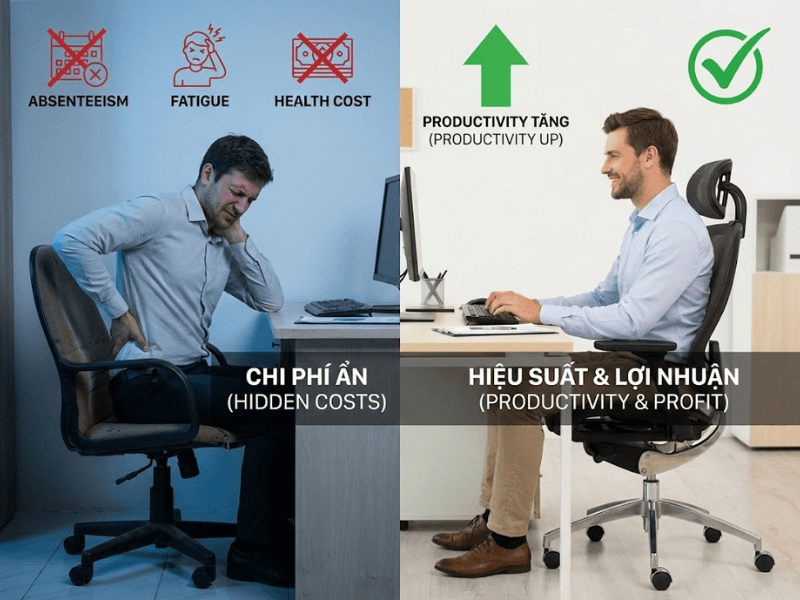
Investing in ergonomic chairs is a rational economic decision. ROI in this context is measured through both tangible and intangible value.
2.1. Improved Productivity
According to research from Cornell University, optimizing seated posture can boost productivity by up to 17.7%. Meanwhile, reports from OSHA (United States) confirm that ergonomically compliant equipment can reduce musculoskeletal disorders by 48%, enabling employees to maintain focus and eliminate unconscious breaks caused by discomfort. A chair that properly supports the lumbar region and neck–shoulder area helps reduce these “invisible pauses,” accelerating task completion.
2.2. Optimizing Long-term Operating Costs (Total Cost of Ownership)
Comparison:
- Conventional office chairs: Lower upfront cost, but a lifespan of only 2–3 years. They are more prone to wear and damage, requiring frequent replacement.
- High-end ergonomic chairs: Higher initial investment, but they can last up to 10–12 years and often come with long-term warranties.
When the cost is distributed over the total years of use, ergonomic chairs actually provide significantly greater cost efficiency for a company’s budget.
3. Measuring ROI When Investing in Ergonomic Chairs
At first glance, calculating ROI for Ergonomic chairs investments may seem complex. However, the equation becomes clearer when broken down into measurable indicators.
3.1. Calculation Framework from Humanscale Experts
Large corporations often begin by applying the framework developed by Humanscale, a global leader in ergonomics. ROI is not calculated solely based on the value of the chair itself, but as a combination of risk reduction and value creation:
- Returns generated: including reduced healthcare insurance costs, fewer sick leave days due to illness, and increased work output.
- Investment costs: including equipment procurement value and user training expenses.
3.2. Financial Simulation Tools: Sit-Stand ROI Calculator
Currently, senior human resource managers also use tools such as the Sit-Stand ROI Calculator. This system allows financial returns to be estimated based on a company’s actual variables:
- Employee salary levels: to calculate the value of each additional hour of effective work.
- Absenteeism rates: to measure cost savings achieved when employees are healthier.
- Productivity growth: the speed of task completion when employees are able to change posture flexibly.
3.3. Insights from Industry Practitioners
Sharing insights on the payback timeline, Samuel Huang, CEO of Tele Ads Agency, emphasized: “Companies should use internal surveys, periodic health reports, and productivity data to track ROI. Positive changes typically become clearly visible after 6 to 18 months, when employees have fully adapted and optimized the way they work with the new equipment. Ergonomic furniture is not an expense; it is a value measured through workforce well-being and organizational efficiency.”
4. Employer Branding: The Key to Attracting and Retaining Talent

In the Gen Z era, workplace wellness is a prerequisite when choosing a company. An office equipped with dedicated ergonomic chairs sends a powerful message: “The company values your health.”
This is a sharp tool in employer branding strategies, helping organizations to:
- Increase engagement among existing employees.
- Create a competitive advantage when recruiting specialists and senior-level talent.
5. Conclusion: Investing in Health Is the Most Sustainable Investment
Ergonomic chairs are no longer a “nice-to-have” option but a mandatory standard for modern corporations. By addressing workforce health challenges, businesses not only protect their human capital but also directly drive sustainable profit growth.
Are you looking for ergonomic furniture solutions for a modern, professional office? Let The City help you optimize your workspace and protect your team’s health today.