Dynamic Training Hubs: Engineering Flexibility with Flip-Seat Training Chairs
Against the backdrop of increasingly exorbitant Grade A office real estate, transforming the training room from a "static" space into a dynamic "competency charging station" has become a vital operational imperative. No longer anchored by space-consuming fixed seating, nesting training chairs represent a fundamental revolution in spatial planning philosophy.
Explore how this intelligent furniture solution maximizes every square meter of floor area, enabling a seamless functional pivot from traditional seminars to interactive workshops in mere moments.
1. Training Environments in the Modern Corporate Landscape
In the operational architecture of today's medium-to-large enterprises, the training room has transcended its role as a mere secondary support space. It has evolved into a strategic "competency charging station" - a vital hub that fuels long-term talent development and radiates the core corporate culture throughout the organization.
However, the reality of Grade A workspaces presents a complex challenge: floor area remains a finite luxury, yet functional requirements are vast and characterized by constant shifts in frequency and format. This paradigm compels leadership to pursue versatile training designs where the agility of furniture - specifically nesting training chairs - serves as the critical determinant of overall operational performance.
2. When Inflexible Training Rooms Become Operational Bottlenecks
A static training layout inadvertently creates several "bottlenecks" within corporate administration:
-
Spatial Inefficiency: Large areas sit vacant or underutilized during periods without scheduled training, leading to a poor return on expensive real estate.
-
Operational Friction in Functional Pivoting: Transitioning from a seminar format to workshops, team huddles, or onboarding sessions becomes slow and labor-intensive, requiring significant manual reconfiguration.
-
Escalating Hidden Costs: Organizations often face the financial burden of renting external venues or the pressure of costly floor renovations as workforce scales fluctuate.
-
Diluted Brand Perception: Forcing an ill-suited furniture setup during sessions with high-level partners or guest speakers compromises corporate prestige and professional image.
3. Nesting Training Chairs: A Spatial Strategy Perspective
In modern interior strategy, a training chair is no longer defined as a mere piece of furniture. Within Grade A office environments, these chairs are viewed as dynamic structural components capable of completely transforming a room’s identity and utility in seconds.
3.1. Instant Spatial Metamorphosis
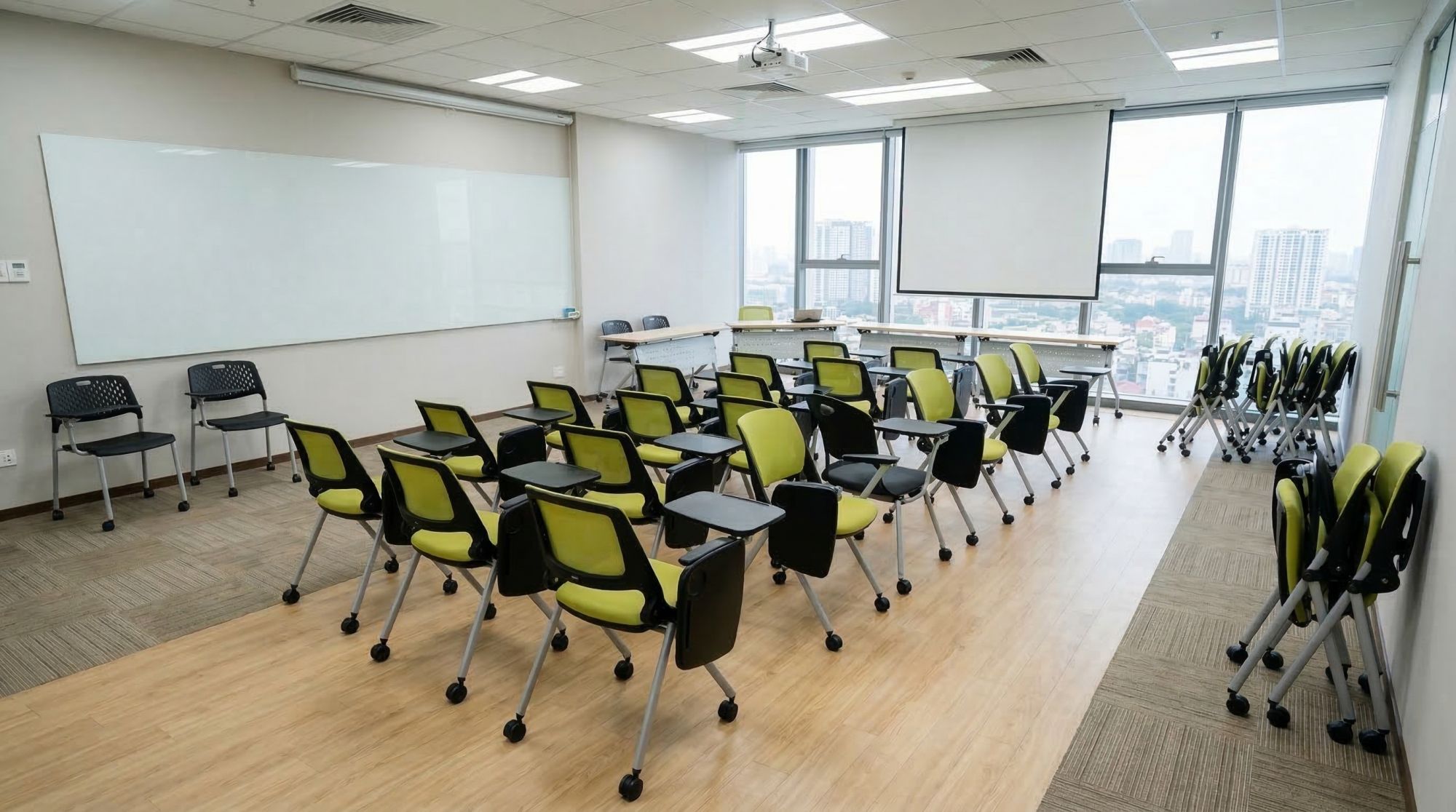
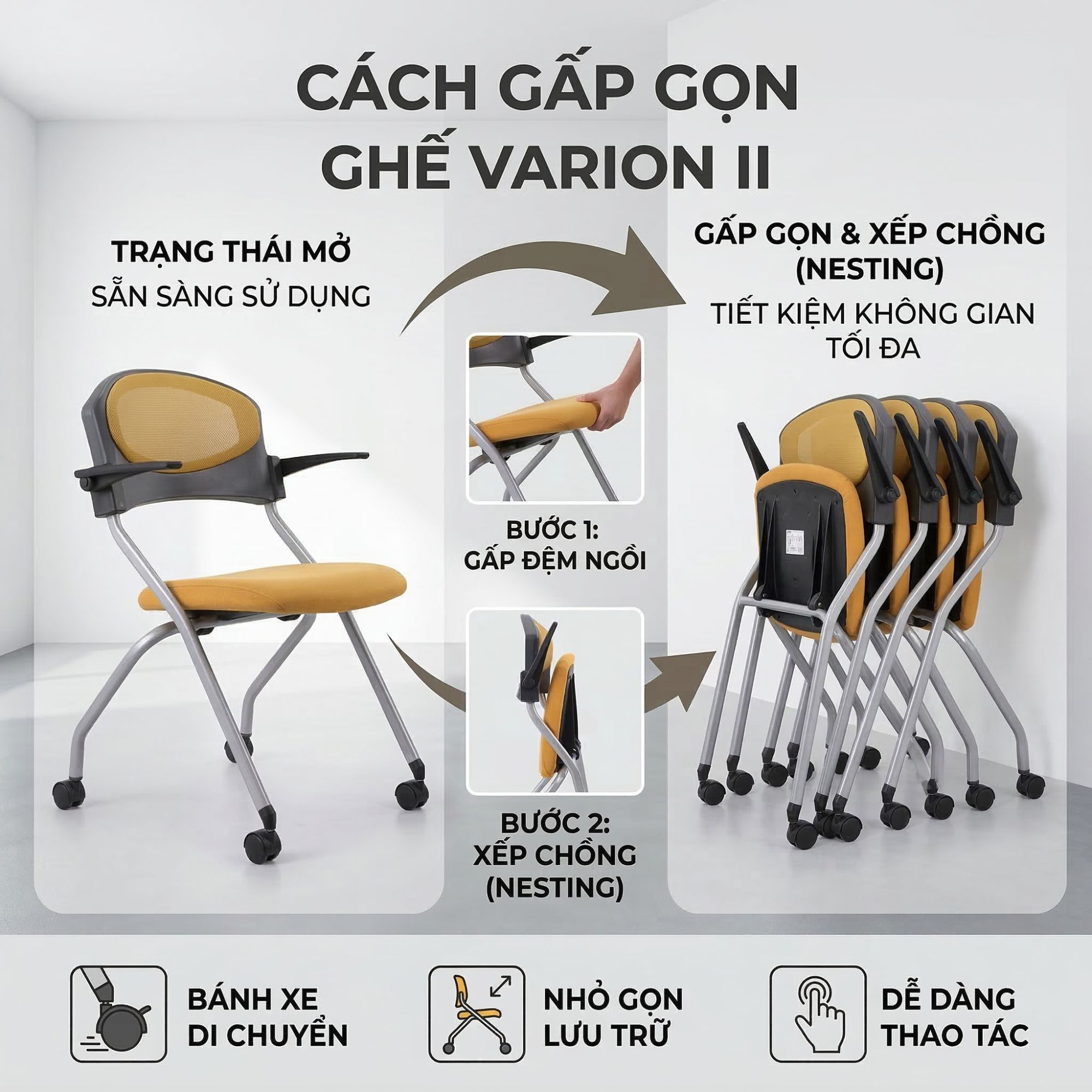
The core value of this solution lies in its ability to liberate floor area instantaneously. Utilizing a sophisticated flip-top seat mechanism and a nesting frame, dozens of chairs can be compacted and moved flush against a wall in an orderly fashion. This allows leadership to execute various spatial scenarios:
-
Classroom Configuration: Optimized for lectures where focus and note-taking are the priorities.
-
U-Shape Layout: Facilitates direct interaction, ideal for management deliberations or board-level discussions.
-
Collaborative Clusters (Group-work): Easily rearrange seats into isolated "discussion islands" without the need for complex dismantling.
-
Total Clearance (Empty Space): Within minutes, all seating is cleared to provide a blank canvas for interactive team-building, internal wellness activities, or high-level networking events.
3.2. Optimizing Circulation and Storage
A common challenge in premium high-rises is limited storage capacity and the high cost of square footage. Nesting training chairs resolve these "pain points" by:
-
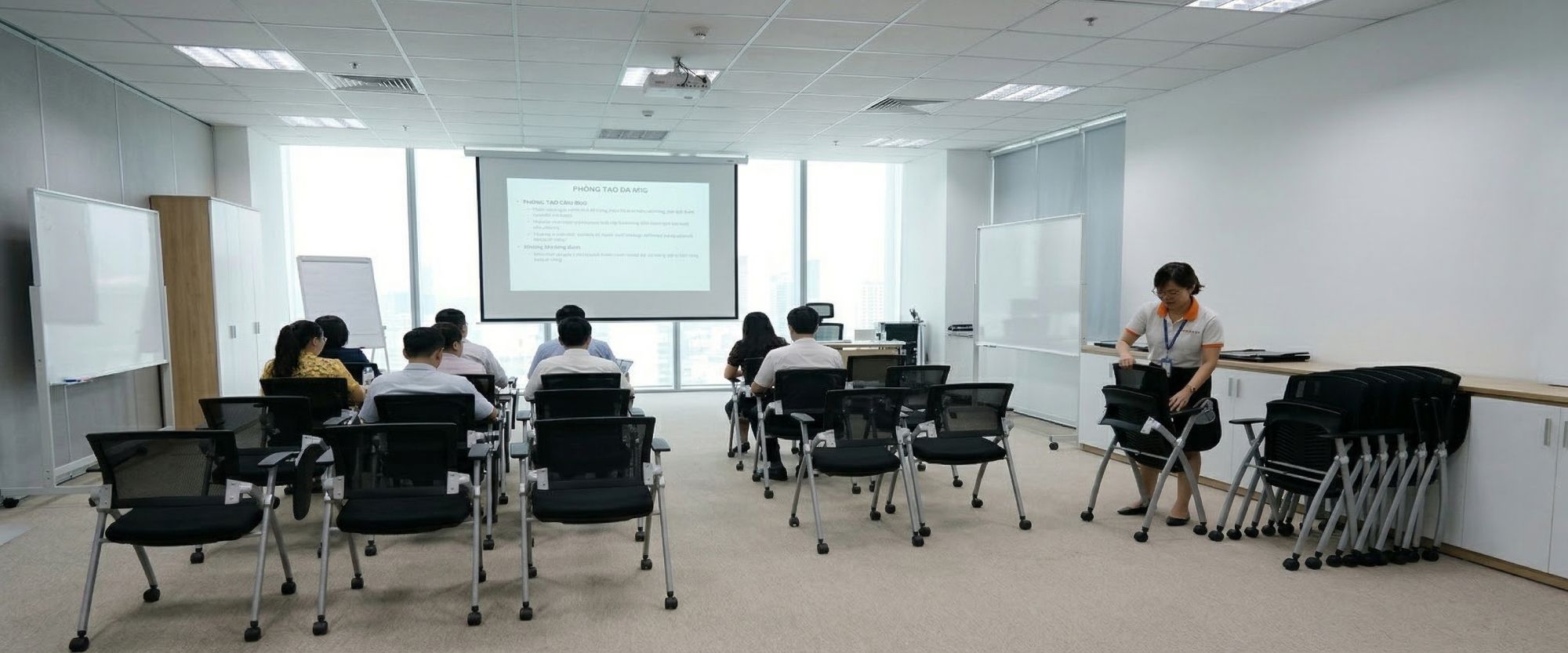
Eliminating Storage Dependency: Rather than requiring a separate storage room, the nesting mechanism allows chairs to be stored discreetly within a small corner of the training room itself, maintaining aesthetic integrity.
-
Enhancing Internal Traffic Flow: Equipped with high-end multi-directional casters, spatial reconfiguration can be performed effortlessly by a single person. This optimizes internal circulation and minimizes disruptions during workshops that require multiple session formats.
By integrating this seating solution, the training room ceases to be a "locked-in" space; it becomes a living entity ready to adapt to the evolving developmental needs of the enterprise.
4. Strategic Selection Criteria for High-End Multi-Purpose Training Chairs
In the segment of luxury offices and multinational corporations, selecting furniture is a calculated decision regarding investment efficiency and employee experience. To meet these rigorous standards, a premium training chair must excel across four core pillars:
4.1. Supreme Agility and Refined Operational Engineering
In contrast to conventional folding chairs that often involve disruptive noise or labor-intensive handling, premium nesting training chairs are defined by their fluid, effortless operation.
-
Intuitive One-Touch Mechanism: The flip-up seat functionality is engineered for swift, seamless use, enabling even a single staff member to entirely reconfigure a 50-person hall in mere minutes.
-
Silent Dampened Caster System: High-performance casters, enveloped in soft PU (Polyurethane), facilitate whisper-quiet mobility across executive carpets or hardwood floors. By eliminating mechanical resonance and preventing surface marking, they preserve the acoustic tranquility essential to a high-stakes professional environment.
4.2. Industrial-Grade Durability and Structural Integrity
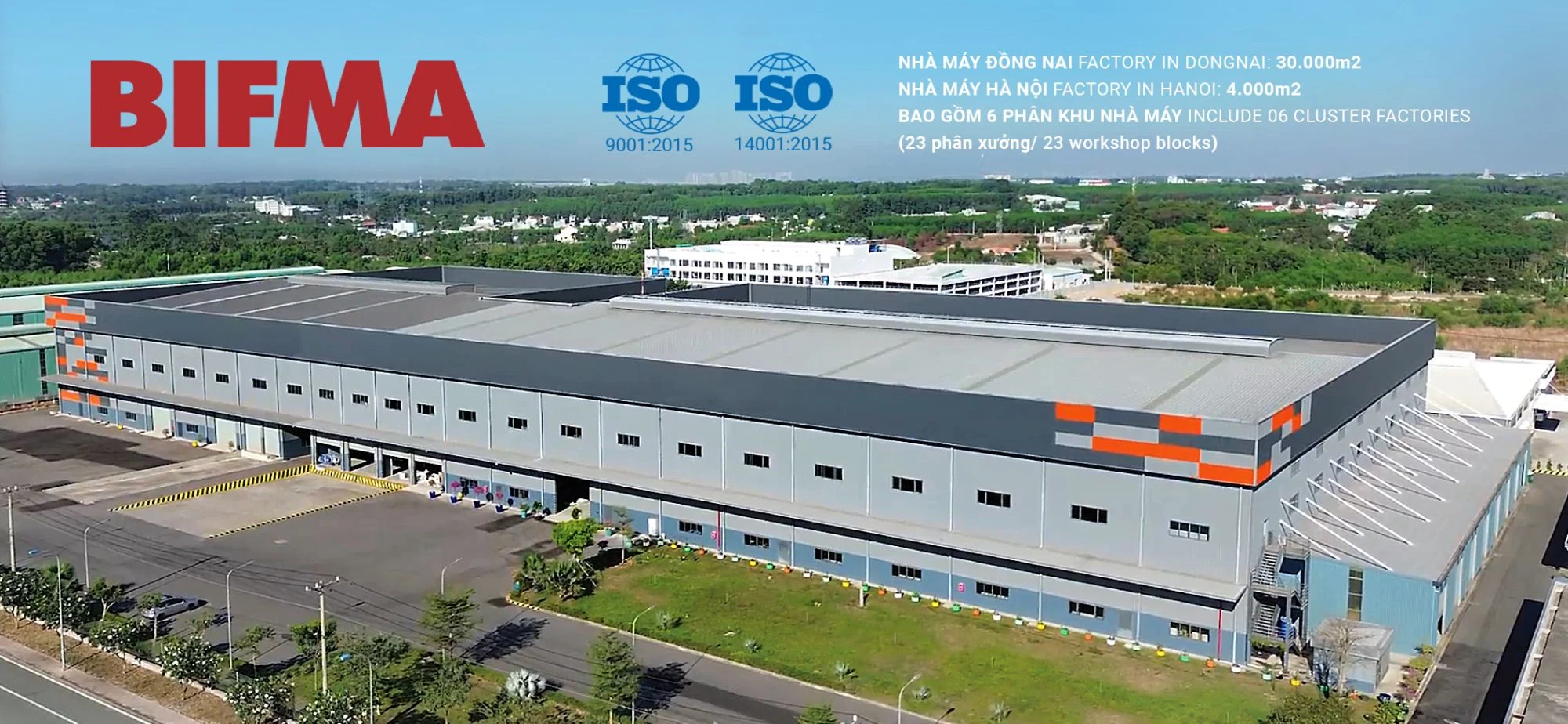
In high-frequency corporate environments, furniture must withstand rigorous, near-constant use. To meet the demands of multinational organizations, a premium chair must adhere to international testing benchmarks such as BIFMA or EN1335.
-
High-Intensity Load-Bearing Frames: Utilizing die-cast aluminum alloys or scratch-resistant powder-coated steel ensures a robust architecture. The structure remains stable and vibration-free even after thousands of deployment cycles.
-
Precision Mechanical Articulation: Every pivot point and joint is engineered with mathematical precision to prevent loosening, rattling, or jamming over time, securing a functional lifespan that spans decades.
4.3. Synchronized Aesthetic Language and Corporate Stature
Training environment furniture should serve as a seamless extension of the overall architectural design language of the office.
-
Eliminating the "Temporary" Aesthetic: High-end nesting chairs replace the flimsy look of traditional folding furniture with sleek, Minimalist lines that project authority. Every detail—from the leg taper to the backrest curvature—is meticulously finished, leaving no room for superfluous elements.
-
Curated Material Palette: The use of high-elasticity technical mesh or premium textiles in neutral tones—such as Charcoal, Navy, or Slate Grey—ensures the space reflects the prestige required for hosting international consultants or strategic partners.
4.4. The Pinnacle of User Experience and Ergonomic Comfort
The efficacy of a training session is directly proportional to the physical comfort of the participants. A premium chair is, at its core, a piece of wellness infrastructure.
-
Advanced Ergonomics: Dynamic backrests provide tailored lumbar support, mitigating spinal pressure and fatigue during intensive 3-to-4-hour seminar sessions.
-
Smart Accessory Ecosystem: Integrated writing tablets are engineered for zero-vibration stability and feature 360-degree rotation, often including dedicated tablet slots or cup holders. Exclusive configurations from The City also feature under-seat storage trays, maintaining a clutter-free environment and upholding the Clean Desk Protocol even in high-density settings.
5. Nesting Training Chairs: The Strategic Equation for Long-term ROI
Investing in a high-tier nesting chair system is a calculated financial decision. In the modern corporate paradigm, procurement has shifted from a "depreciating expense" to an investment in operational infrastructure.
Choosing The City’s premium nesting solutions represents a move toward sustainable value. By optimizing floor area utility and reducing the need for external venue rentals, these systems provide a return on investment that far exceeds their initial acquisition cost, serving as a permanent asset in the enterprise's growth journey.
5.1. Maximizing ROI per Square Meter of Floor Area
In premium high-rise developments, rental expenditure is typically among the largest fixed costs for any organization. A training room equipped with fixed seating is often monopolized for a single purpose, meaning that valuable square footage sits "idle" for a significant portion of the working week.
-
Increasing Utility Rates: Nesting chairs empower the space to pivot instantly. Once a training session concludes, the room can immediately serve as a briefing hall, workshop studio, or collaborative hub.
-
Driving Profitability: By increasing the frequency of room utilization, the ROI (Return on Investment) for every square meter is pushed to its peak. This transforms "static" real estate into a high-yield, dynamic asset.
5.2. Mitigating Opportunity and Renovation Costs
Rather than allocating thousands of dollars to external convention centers whenever the workforce scales up or a major event occurs, a flexible furniture system allows the enterprise to remain self-sufficient and agile.
-
A Solution for Scalability: As headcount fluctuates, you no longer need to consider the disruption of structural renovations or moving walls. Simply recalibrate the configuration of your nesting chairs to adapt to the new requirement.
-
Reducing Infrastructure Pressure: A versatile room equipped with these solutions can effectively perform the roles of three distinct functional spaces, significantly reducing initial capital expenditure (CAPEX) on interior fit-outs and specialized design.
5.3. Perfect Alignment with Hybrid and Agile Work Models
The shift toward Hybrid Work (combining remote and onsite presence) demands that office environments possess high levels of adaptability.
-
Demand-Based Configuration: Nesting chairs allow leadership to effortlessly expand the floor layout to ensure comfortable spacing when required or contract it to foster intimacy and connection during small-group huddles.
-
Long-Term Durability vs. The "False Economy": Investing in premium solutions from The City prevents the "buy cheap, buy twice" scenario. While generic chairs often suffer mechanical failure after a year of high-frequency use, our high-end solutions maintain structural integrity and aesthetic prestige throughout the office’s lifecycle, minimizing maintenance and replacement overheads.
From a governance perspective, nesting training chairs are more than furniture—they are a tool for spatial risk management, ensuring the organization is prepared for any market fluctuation.
6. Conclusion: The Foundation of a Resilient Training Ecosystem
In modern workplace design, flexibility is power. Investing in a high-performance nesting chair system is not merely a procurement task; it is an investment in an intelligent, long-term operational framework.
The City is dedicated to partnering with visionary enterprises to engineer world-class training environments—where knowledge is shared seamlessly and every square meter is optimized with artistic precision.
Ready to transform your training space into a high-yield asset? Contact The City today for a tailored spatial consultation.