Inspection Checklist for Purchasing Office Chairs in Large Quantities

In large-scale enterprises, especially multinational corporations and foreign-invested companies in Vietnam, purchasing office chairs is not simply an interior procurement item. It is a decision that directly impacts employee working experience, office image, and long-term operational costs.
When implementing large-volume office chair orders, actual product quality is only truly controlled at the inspection and acceptance stage. Without a clear checklist, businesses can easily fall into a situation where delivery meets quantity requirements but not necessarily quality expectations.
This article provides a quality inspection checklist for accepting large office chair orders, developed from a risk management perspective, and tailored to enterprises that require a refined, professional, and high-standard working environment.

1. Why do businesses need an inspection checklist when purchasing office chairs in large quantities?
In practice, many companies still inspect office chairs based on visual judgment or perform inspections in a formalistic manner. This approach carries significant risks, especially when the number of chairs reaches dozens or even hundreds.
1.1. Common risks when inspecting office chairs based on subjective judgment
The chairs are delivered in the correct overall model, but show minor differences in materials, color, or finishing compared to the approved sample. Quality inconsistency exists within the same batch, where only some chairs meet the standard while others have minor defects that are difficult to detect immediately. Issues related to adjustment mechanisms, stability, or durability only appear after a period of use, when corrective actions become more complex and costly.
1.2. The inspection checklist as a management tool, not a formality
For large enterprises, an inspection checklist when purchasing office chairs is not just about “checking whether the chair looks good.” It is a tool that helps standardize processes between procurement, administration, and suppliers. The checklist establishes a clear technical basis for quality evaluation, deviation recording, and transparent communication with suppliers from the outset. More importantly, it enables businesses to proactively manage risks instead of dealing with consequences after the office is already in operation.
2. Comprehensive inspection checklist before accepting an office chair purchase order
The inspection checklist should be applied directly on site, based on specific inspection categories, rather than relying on general assessments.
2.1. Checking quantity and consistency of the chair batch
First, compare the actual delivered quantity with the contract and delivery list. Beyond checking for shortages or excess, it is essential to review whether models, versions, and chair configurations are consistent. In large orders, discrepancies often occur in details such as chair bases, armrests, casters, or adjustment mechanisms. If not carefully inspected, these details can directly affect user experience and spatial consistency.
2.2. Checking appearance and product finishing
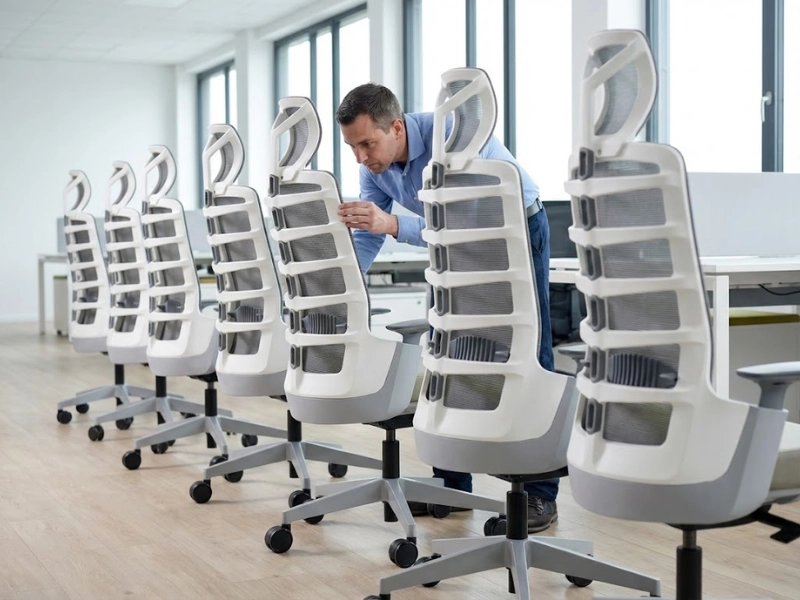
Inspect the entire chair surface under both natural light and office lighting to identify scratches, misaligned stitching, surface defects, or color deviations. Place multiple chairs side by side to assess uniformity in color, materials, and form. For offices that require a professional image, this consistency is especially critical, as just a few mismatched chairs can disrupt the overall space.
2.3. Checking frame structure and stability during use
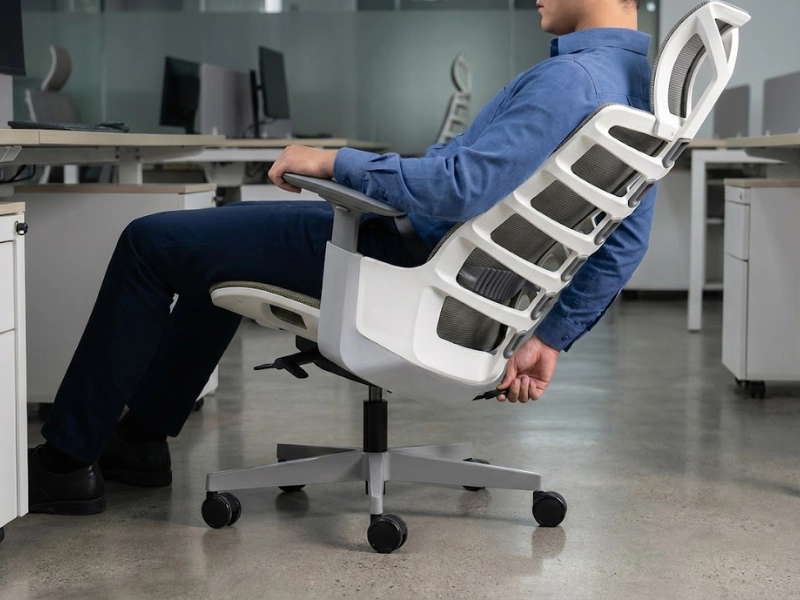
Sit on the chair in basic working postures, shift weight, and make light movements to test stability. The chair frame, base, and joints should remain stable, without wobbling or unusual noises. This step helps identify early structural defects that may compromise safety or reduce product lifespan.
2.4. Checking adjustment mechanisms and ergonomic functions
All adjustment mechanisms such as seat height, backrest recline, tilt lock, and armrest adjustments must be tested according to the specifications stated in the office chair purchase contract. Operation should be smooth, without jamming or excessive play, and consistent across all chairs in the same batch. For high-intensity work chairs, this consistency directly affects employee experience and internal evaluations of equipment quality.
2.5. Checking materials in direct contact with users
Materials used on the seat, backrest, and armrests should be carefully examined for tension, elasticity, and shape recovery. Materials should not emit unusual odors or cause discomfort during prolonged contact. This factor is often overlooked during inspection but has a significant impact on daily user experience.
3. Commonly overlooked points when inspecting office chair purchases
Even enterprises with rigorous procurement processes often miss certain critical points during inspection.
3.1. Skipping random checks across multiple chairs within the same batch
Many organizations inspect only a few representative chairs. However, defects rarely appear uniformly and are often scattered across different boxes or production batches. Randomly inspecting chairs from various delivery positions helps detect potential issues early.
3.2. Failing to cross-check technical specifications in the contract
Some issues only become apparent when comparing detailed specifications such as load capacity, material composition, or manufacturing standards. Without linking the inspection checklist to the signed technical documentation, businesses lack a solid basis for resolution in case of disputes.
3.3. Rushed inspection due to project timeline pressure
Office handover schedules often compress the inspection phase. As a result, issues only surface after the chairs are in use, leading to maintenance costs, replacements, and negative impacts on employee experience.
4. Recommended office chair inspection process for large-scale enterprises
To maximize the effectiveness of the checklist, businesses should approach office chair inspection as a complete process.
Step 1: Preparation before inspection
Clearly confirm the approved samples, configurations, and agreed technical specifications. Assign responsible personnel for inspection, ensuring sufficient time and authority for evaluation.
Step 2: On-site inspection
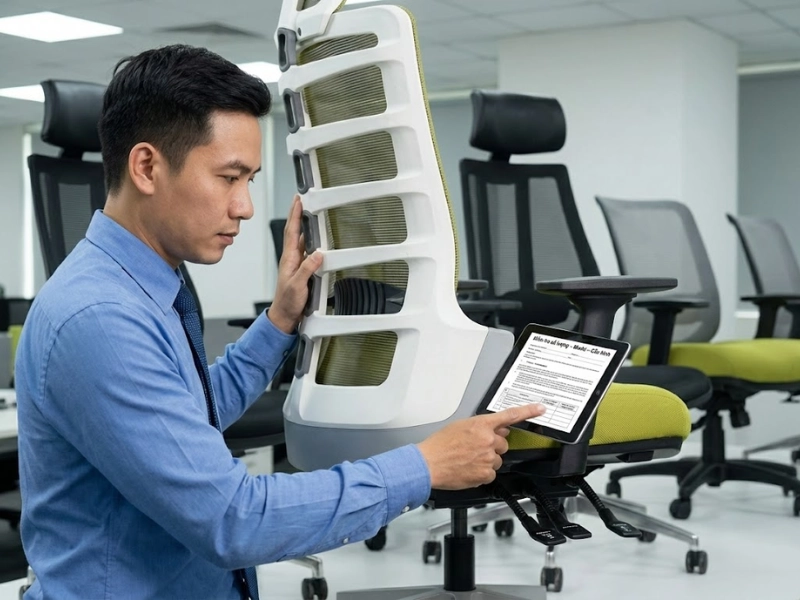
Apply the checklist by inspection category and immediately record any issues with photos and written reports. Early documentation enables faster resolution and prevents problems from extending into the operational phase.
Step 3: Post-use inspection after a trial period
For high-intensity work chairs, an additional evaluation after a short period of use is recommended. This provides a practical assessment of stability and long-term performance of adjustment mechanisms.
5. How The City approaches quality in large-scale office chair projects
In large office chair procurement projects, The City does not treat office chairs as standalone products, but as integral components of a workplace ecosystem.
Standardizing configurations and controlling quality from the outset
The City advises on chair configurations tailored to specific user groups and usage areas, minimizing inconsistencies during large-scale deployment. This standardization ensures a clear and consistent inspection process.
Transparent technical documentation and inspection criteria
All technical specifications and quality criteria are clearly defined from the beginning, enabling businesses to proactively control and evaluate quality. The City supports clients throughout the inspection process rather than simply delivering products.
Long-term partnership rather than one-time delivery
For large enterprises and FDI companies, chair quality is evaluated not only at delivery but throughout the entire usage lifecycle.
The City focuses on long-term stability and real-world end-user experience.
6. Conclusion
When purchasing office chairs in large quantities, an inspection checklist is not a procedural formality but a critical risk management tool. For businesses that require a refined, professional, and sustainable working environment, chair quality must be controlled through clear standards rather than subjective judgment. A well-structured inspection checklist forms the foundation for protecting procurement decisions and ensuring long-term investment value for the workplace.